Dr. C S Gokhale, Dean NICMAR Pune and Ex-Professor Goa Engineering College delivered a talk on “Design and construction of Coastal Structures” on 5th March 2018 at Goa Engineering College. This talk was attended by about 70 delegates comprising of faculty and UG students of Civil Engineering and PG students of Masters in Foundation Engineering and Structural Engineering.
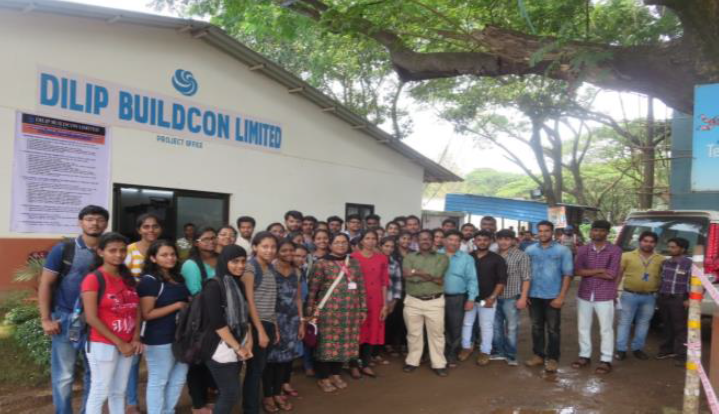
A field visit was organized by the IGS Goa chapter to the New Zuari bridge site at Cortalim – Goa where a 8-lane bridge, 640 m long, having central cable stayed spans, with steel deck overlain by precast slabs is being constructed parallel to the existing road and Railway bridges across the Zuari river. The site was visited on 4th October 2017 at 11.30 a.m. by about 40 faculty members and students of M. E (Foundation Engg.) and M.E (Structural Engg.) were present. Later on the group visited a soil investigation site at National Centre for Antarctica and Ocean Research (NCAOR) at Vasco, Goa where a soil investigation consultancy project was undertaken by College. At the site, four boreholes of 12.5m depth were drilled. The proposed site will house a shed for handling containers and an Ice Core lab.
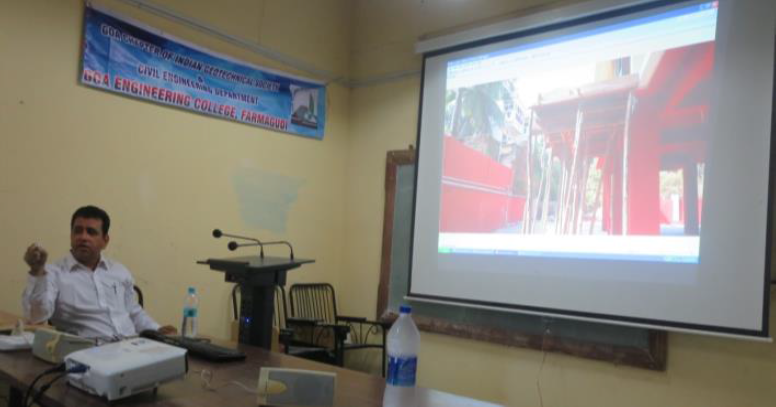
An expert talk on "Practical aspects on design and construction of structures and foundations" by Er. Ravindra Palyekar, alumnus of Goa Engineering College was organized by IGS Goa chapter at Goa Engineering College Farmagudi on 29/09/2017. Er. Palyekar highlighted on various aspects of Foundation design and presented a number of case studies on how things can go wrong on the field. The talk was attended by over 30 faculty members and PG students.
Dr. Nikhil N. V., research associate, Dept. of Civil and Environmental Engineering, KAIST, Korea, and proud alumnus of Goa Engineering College presented a lecture on case studies in landslides in Korea on 13th April 2017 at Goa Engineering College. It was attended by 44 post-graduate, graduate students of GEC, faculty members and IGS members.
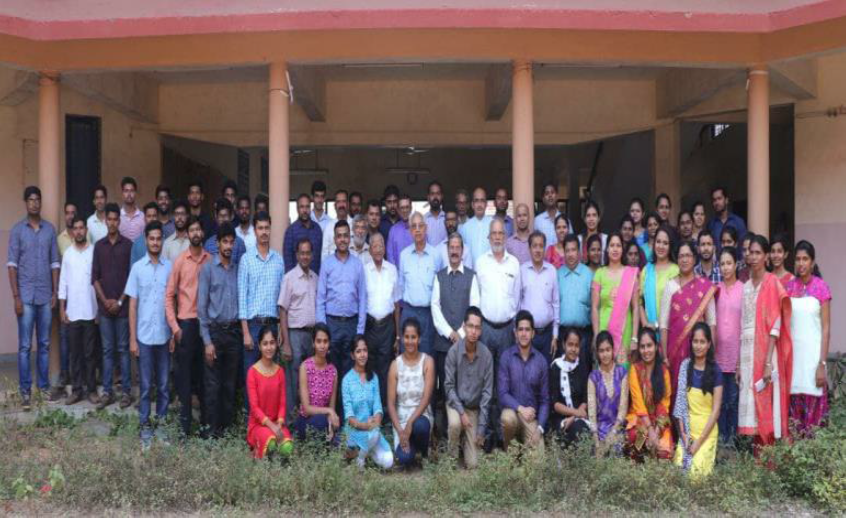
A seminar on Soil investigations and forensic engineering was held on 29th April 2017 along with the Dr. Victor deMello Goa Lecture. Prof. Babu presented two lectures on “Designing Filter Criteria for Dams” and “Importance of Forensic Engineering in Civil Engineering Practice”. Prof. Deepankar Choudhury presented a lecture on “Dynamic Soil Properties and Seismic Design of Tailing Ponds”. Prof. A. M. Deshmukh, ex-Professor Goa Engineering College, delivered talk on “Flexible Mats for Improving Bearing Capacity of Soils”. All the talks were very informative, thought-provoking and very interesting and were well appreciated by the delegates.
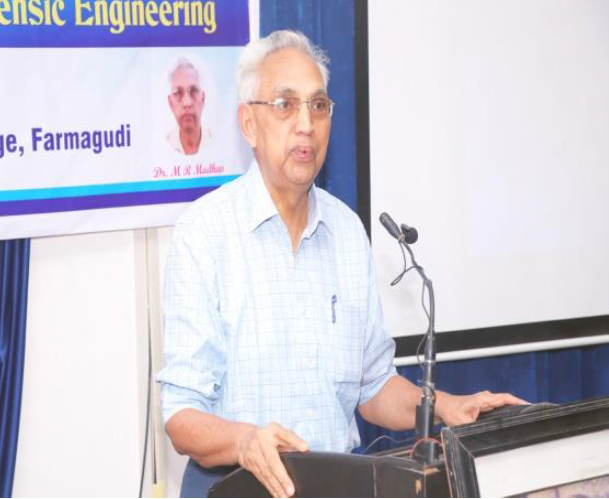
Goa Chapter of Indian Geotechnical Society and Civil Engineering Department of Goa Engineering College conducted the First prestigious Dr. Victor deMello Goa Lecture and seminar on Soil Investigations and Forensic Engineering on 29th April 2017 at Goa Engineering College, Farmagudi. The first Dr. Victor deMello lecture was presented by Prof. Madhira Madhav, Professor Emeritus IIT Hyderabad and JNTU on the topic “Carrying Capacity of Foundations on and in the Ground”.
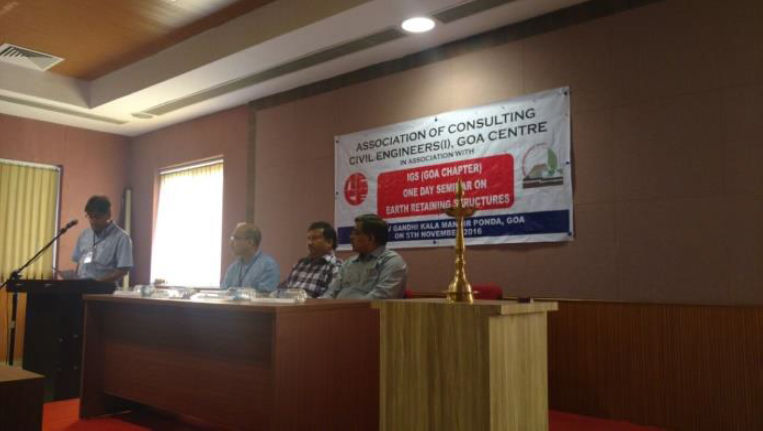
Goa Chapter of IGS in association with Association of Consulting Civil Engineers (India) Goa Chapter organized a one day seminar on Earth retaining Structures on 5th November at Rajiv Kala Mandir, Ponda Goa. The resource persons for the seminar were Prof B V S Viswanadham and Prof Deepankar Choudhury, Professors IIT Bombay. About 70 delegates from industry, academia, government organization and sponsoring organisations participated in the seminar. Prof. Viswanadham delivered talks on “Design of earth retaining structures” and “reinforced earth and gabion walls along with various case studies” while Prof. Deepankar Choudhury delivered talk on “Design of deep excavations and case studies”. Ms. Sneha Khadbadi, Sr. Manager from Maccaferri India Ltd. made a corporate presentation on Maccaferri products and case studies on important works carried out by them.
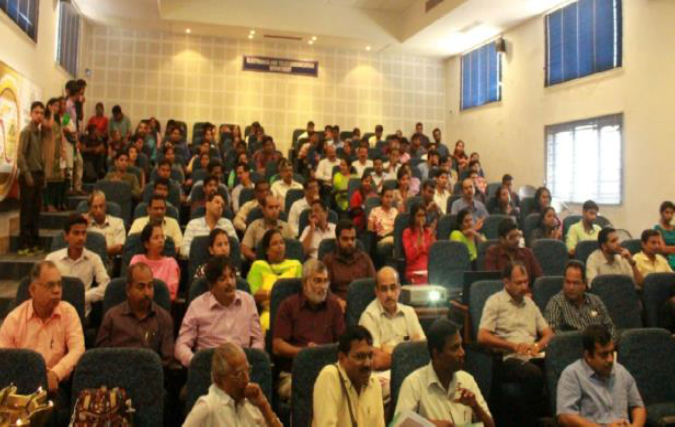
IGS Goa Chapter, the Civil Engineering Department of Goa Engineering College (GEC) organised one day advanced seminar on “Soil response and seismic design of foundations” at Goa Engineering College on Thursday, 27th October 2016 from 9.30 am to 5.30 pm. Seminar was inaugurated Prof. Ikuo Towhata, Vice President (Asia) of ISSMGE, a former Professor of University of Tokyo, Japan and a Distinguished Visiting Professor of IIT Bombay, India. Prof. Towhata also stressed on the importance of soil investigations and maintenance of structures as well. He also delivered theme talk on soil response and seismic design of foundations citing several case studies. Prof. Deepankar Choudhury from IIT Bombay delivered talk on “Seismic design of pile foundations and combined piled raft foundations” and Prof. Santiram Chatterjee from IIT Bombay delivered talk on “Design of offshore shallow foundations”. Over 140 delegates from Goa and nearby States comprising of delegates from industry, academia, Govt. organizations and UG and PG students attended the seminar.
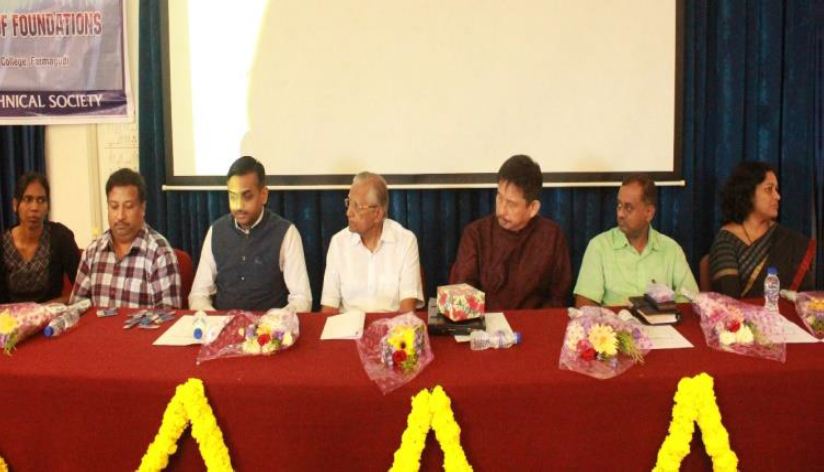
New Goa Chapter of Indian Geotechnical Society (IGS), which is the 41st local chapter of IGS was inaugurated on Thursday 27 October 2016 at Goa Engineering College (GEC), Goa, India in the august presence of Prof. Ikuo Towhata, Vice President (Asia) of International Society for Soil Mechanics and Geotechnical Engineering (ISSMGE) and Prof. Deepankar Choudhury, National Executive Committee Member of IGS.
ISSMGE TC-107 Symposium on Residual tropical Soils
keynote lecture by Prof. M R Madhav, Adjunct Prof. IITH along with other lectures.
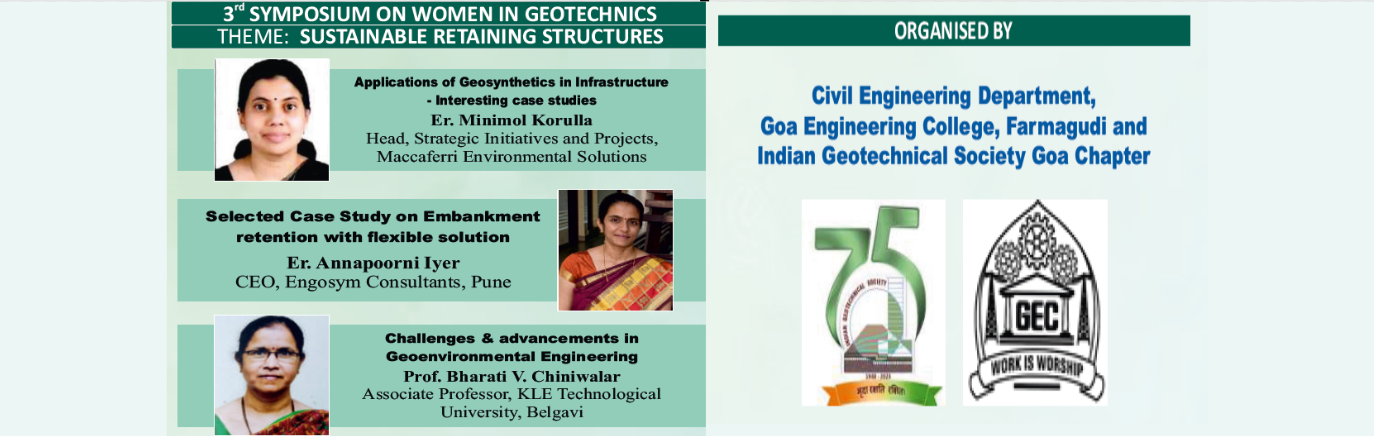
Indian Geotechnical Society Goa Chapter started the innovative Symposium on Women in Geotechnics, the first of its kind, organized to bring together and honour the illustrious women in the field of Geotechnical Engineering who have created a mark in this field in 2018. The third Symposium on Women in Geotechnics is scheduled on 1st December 2023 from 02.30 to 05.30pm, on the themes:
Sustainable retaining structures
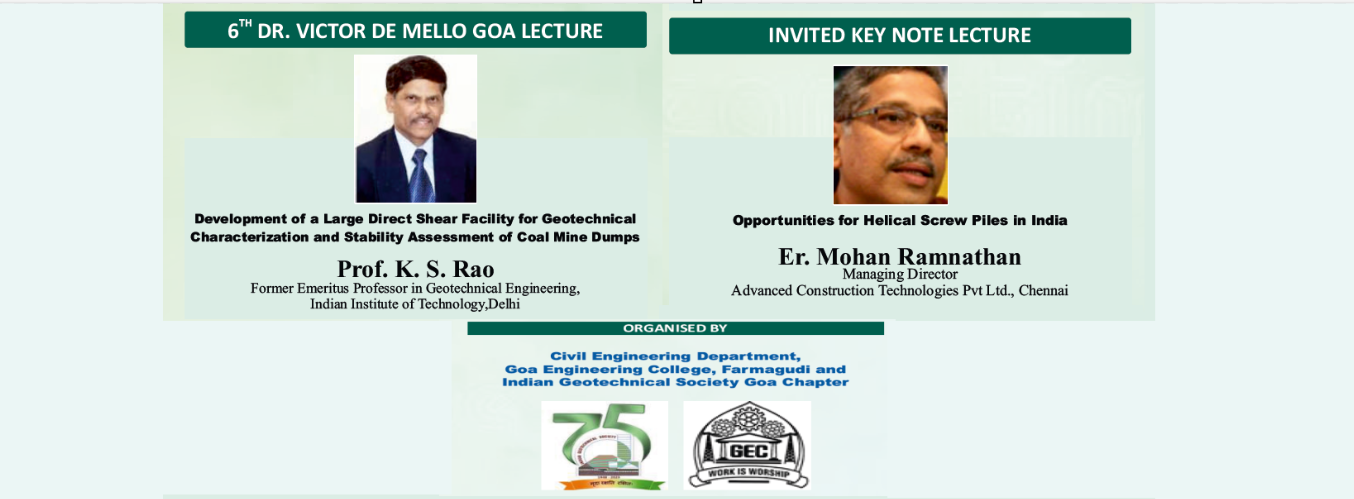
6th Dr. Victor de Mello Goa Lecture to be delivered by Prof. K S Rao, IITD on 01/12/2023 at 11.00am
-210823011132.JPG)
On 28/07/2023, IIT (ISM) Dhanbad had a thought-provoking lecture on "Sustainability and its Assessment in Geotechnical Engineering" from Professor Dipanjan Basu of the University of Waterloo, Canada. Prof. Basu emphasised the critical role that sustainability plays in geotechnical infrastructure throughout the session. In relation to geotechnical engineering projects, he went into more detail about the 4Es of sustainability: Engineering, economy, environment, and equity. The IIT (ISM) Dhanbad students had a stimulating conversation with Prof. Basu during which they learned insightful tips for implementing sustainable practices into their next engineering endeavours. The talk had a long-lasting effect on the students, motivating them to put sustainability first when pursuing careers. This lecture was organized under the aegis of Indian Geotechnical Society Dhanbad Chapter.
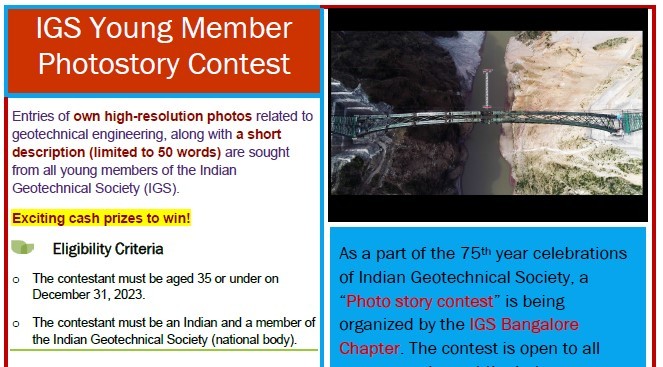
As a part of 75th year celebrations of IGS, IGS Bangalore Chapter is organizing IGS Young Member Photostory contest. The contest and the exciting cash prizes will be incentives for the talented young geotechnical engineers to become the members of IGS. The contest is open to all young members of the Indian Geotechnical Society, working in field/lab/academia, including students under 35 years age.
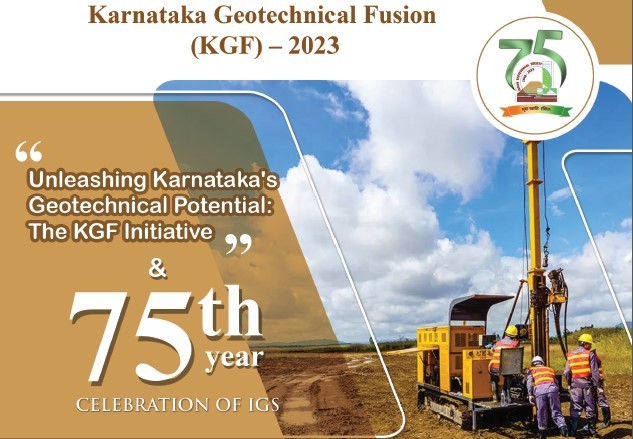
Karnataka Geotechnical Fusion (KGF) 2023 is a conference beingly jointly organized by all these chapters as a fitting tribute to the contributions of Karnataka in shaping up the IGS to its current stature and to fuse the IGS chapters of Karnataka into synergetic collaborations towards solving important geotechnical problems of the state.
Organised by:
IGS Bangalore Chapter
IGS Mysuru Chapter
IGS Hubli Chapter
IGS Surathkal Chapter
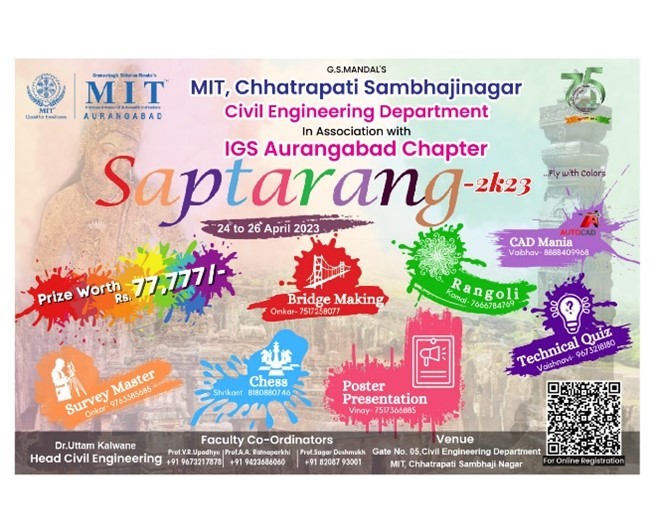
The Civil Engineering Department MIT, along with IGS Aurangabad Chapter Conducted Saptaranga-2K23 Event from 24th to 26th April 2023. This Year Saptarang-2K23 received an overwhelming response in all its events and was a grand success.
Saptarang-2K23 was mainly organized to encourage all round growth of students. Participants from all Engineering Colleges of Chhatrapati Sambhajinagar (Aurangabad) were invited for the event. Saptarang-2K23 started on 24/04/2023 at 10.00am in hall no. 110 with inauguration ceremony. Dr. V. G. Achwal & Dr. U. B. Shinde were chief guests for the event. The Faculty Coordinators for the event were Prof. Ajay Ratnaparkhi, Prof. Sagar Deshmukh, Prof. V.R. Upadhye & all staff of Civil Engineering Department supported in coordinating Saptarang-2K23.
Monthly Webinars "RENDEZVOUS 2.0" on the first Monday of every month. A technical Talk being given on a geotechnical engineering topic by experts.
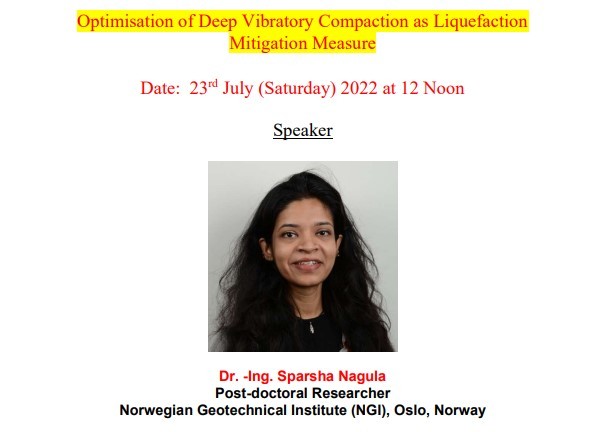
The current world population ranges around 7 billion and is ever increasing; the rising population has created huge demand of land for various infrastructure facilities. This has pushed the engineering community to use land which previously in history was considered unsuitable for any construction. Soil liquefaction caused by earthquake loading is a major threat to infrastructure. Loose saturated sands when subjected to seismic loading develop high excess pore water pressures and shear strains that may lead to soil liquefaction. Deep vibratory compaction method is an established ground improvement technique for granular soils. This technique is used to improve the properties of loose to medium dense granular soils by compacting deep layers of the soil and therefore reducing settlements, increasing the vertical bearing capacity, and aiding in liquefaction mitigation. The lack of analytical design methodology and dependence on field experience of past projects to ascertain liquefaction mitigation potential inhibits the efficient use of deep vibratory compaction. This talk would highlight insights from a combination of physical modelling, field measurements and numerical simulations that were carried out to analyse deep vibratory compaction. Followed by seismic numerical simulations of saturated sand, compacted by deep vibratory compaction to analyse the feasibility and effectiveness of this method for mitigating the liquefaction hazard and its consequences.
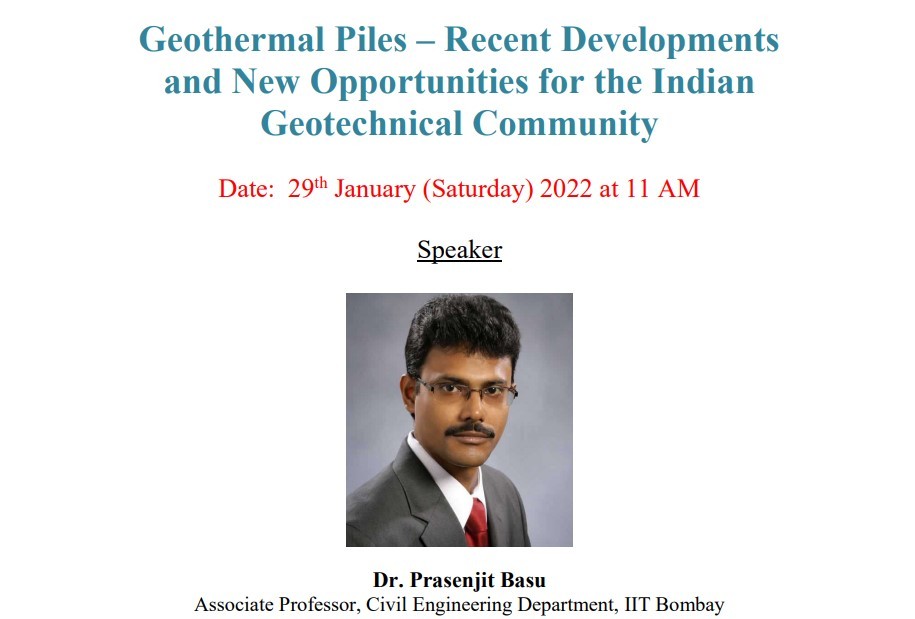
Geothermal piles serve the dual purpose of supporting structural load and harvesting energy from the ground underneath. Energy harvested through geothermal piles (also referred to as heat exchanger piles or energy piles) are often used as an auxiliary measure to meet the space heating and cooling energy demand of residential and commercial buildings. Design and implementation of pile-anchored energy harvesting technology is largely influenced by successful operations of geothermal boreholes, which have been in use over the last several decades. Accordingly, heavy reliance on experience and empirical rules has partially deterred the rate of adoption of this technology in routine foundation engineering practice. While the use of the dual-purpose piles is increasingly being popular in different parts of the world (e.g., Europe, USA, and Eastern Asia), this sustainable foundation alternative is yet to be explored and adopted in the Indian geotechnical engineering practice. Significant research and development in this area over the past decade has paved the way for scientific understanding of critical aspects of geothermal pile design. This presentation will provide a basic overview of geothermal piles and describe some recent advancements in predictive thermal performance assessment of these piles. Field, operational, and design parameters that play crucial roles in thermal performance assessment of these piles will be discussed. Moreover, in the light of contemporary research, this talk will briefly discuss physics governing pile-soil heat exchange under different subsurface conditions. It is anticipated that a synchronized effort involving both academia and industry can facilitate identification of future directions towards exploration of this sustainable energy harvesting alternative in the Indian context and adoption of this innovative foundation technology in Indian geotechnical engineering practice.


-090623070814.png)